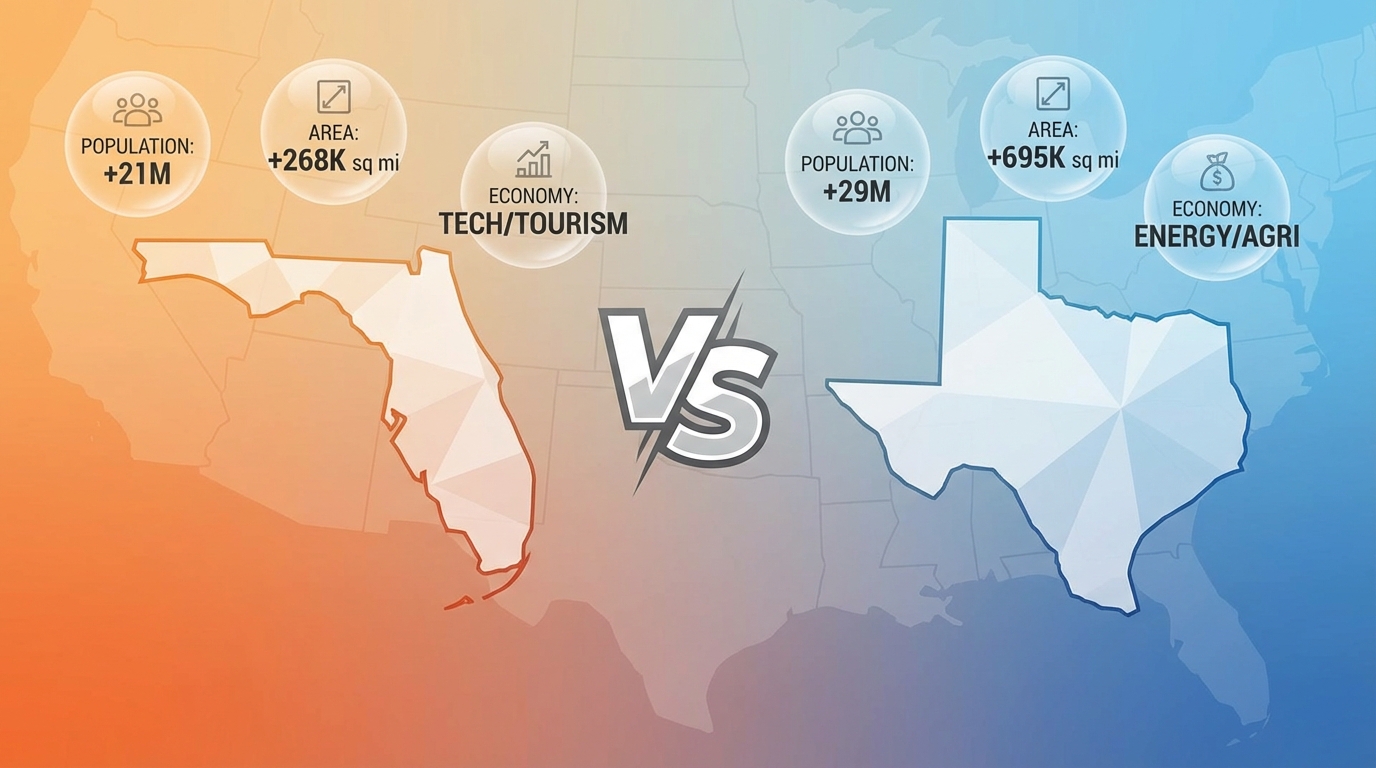
Florida vs. Texas Annual Report: Key Differences
Florida vs. Texas Annual Report: Key Differences
Florida and Texas share a major distinction that makes them both attractive to business owners: neither state imposes a personal income tax. This tax-friendly reputation has made both states magnets for entrepreneurs, freelancers, and growing companies looking to minimize their tax burden. However, when it comes to annual business filing requirements, Florida and Texas take quite different approaches.
Florida requires a straightforward annual report filed with the Division of Corporations. Texas, on the other hand, requires a franchise tax report filed with the Texas Comptroller of Public Accounts. These are fundamentally different types of filings with different requirements, different fee structures, and different consequences for non-compliance. In this detailed comparison, we will break down every key difference so you can understand your obligations in each state.
Side-by-Side Comparison Table
| Requirement | Florida | Texas |
|---|---|---|
| Filing Name | Annual Report | Franchise Tax Report (also called Public Information Report) |
| Filing Frequency | Annually | Annually |
| Deadline | May 1 | May 15 |
| LLC Filing Fee | $138.75 | $0 if below no-tax-due threshold; varies if above |
| Corporation Filing Fee | $150.00 | $0 if below threshold; franchise tax if above |
| Nonprofit Filing Fee | $61.25 | $0 (nonprofits are generally exempt) |
| Franchise Tax | None | Yes (0.375% to 0.75% of taxable margin, with no-tax-due threshold) |
| No-Tax-Due Threshold | N/A | $2.47 million in annualized total revenue (2024 threshold) |
| Late Penalty | $400 flat fee | 5% penalty if 1-30 days late; 10% if more than 30 days late, plus interest |
| Filing Method | Online via SunBiz.org | Online via Texas Comptroller WebFile or by mail |
| Required Information | Officers, registered agent, addresses, FEIN | Revenue/financial data, officer info, registered agent, SIC code |
| Consequence of Non-Filing | Administrative dissolution after September | Forfeiture of right to transact business; tax liens |
| State Income Tax | None | None (but franchise tax applies) |
Detailed Breakdown
What Each State Requires
Florida: Florida requires every registered business entity (LLCs, corporations, limited partnerships, and nonprofits) to file an annual report with the Florida Division of Corporations through the SunBiz.org portal. This report updates the state on your business's current officers, registered agent, addresses, and FEIN. It is primarily an informational filing -- there is no tax calculation involved.
Texas: Texas requires most business entities to file a franchise tax report with the Texas Comptroller of Public Accounts. Despite its name, this is not just a report -- it involves calculating whether your business owes franchise tax based on its total revenue and taxable margin. Even if your business owes no tax (because it falls below the no-tax-due threshold), you must still file the report. Additionally, businesses must file a Public Information Report (PIR) along with the franchise tax report, which updates the state on officers, directors, managers, and registered agent information.
Deadlines
Florida: The annual report deadline is May 1. The filing window opens January 1.
Texas: The franchise tax report deadline is May 15. The reporting period covers the previous calendar year's activity. New businesses that were formed in the current year may have a different initial filing deadline.
Both states have spring deadlines, but Florida's May 1 deadline comes two weeks before Texas's May 15 deadline. If you operate in both states, remember to file your Florida report first.
Fees and Taxes
Florida: Florida charges flat filing fees with no tax component:
- LLC: $138.75
- Corporation: $150.00
- Limited Partnership: $150.00
- Nonprofit: $61.25
Texas: Texas's system is dramatically different. The franchise tax is calculated based on your business's total revenue and taxable margin. The tax rate is 0.75% of taxable margin for most entities, or 0.375% for qualifying wholesalers and retailers. However, if your business has annualized total revenue below the no-tax-due threshold (approximately $2.47 million as of 2024), you owe no franchise tax but must still file the report. There is no separate filing fee for the franchise tax report -- the tax itself is the cost.
This means that for small businesses below the no-tax-due threshold, Texas is effectively free to file (no filing fee and no tax owed), while Florida charges a fixed fee regardless of revenue. However, for larger businesses, Texas's franchise tax can be substantially more expensive than Florida's flat filing fee.
Late Penalties
Florida: A flat $400 late fee is applied to any annual report filed after May 1. This penalty is the same regardless of how late the filing is, making it predictable but painful.
Texas: Texas applies a 5% penalty on the tax due if the report is 1 to 30 days late, and a 10% penalty if it is more than 30 days late. If no tax is due, there is no monetary penalty for late filing, but the business may still face forfeiture of its right to transact business. Interest also accrues on unpaid tax amounts.
Required Information
Florida: The Florida annual report requires basic business information: entity name, document number, principal address, mailing address, registered agent and address, officers/directors/members with addresses, and FEIN. There is no financial data required.
Texas: The Texas franchise tax report requires financial information including total revenue, cost of goods sold or compensation deductions, and the calculation of taxable margin. The Public Information Report requires officer, director, or manager information, registered agent details, principal office address, and SIC (Standard Industrial Classification) code. This makes the Texas filing significantly more complex than the Florida filing.
Consequences of Non-Filing
Florida: If the annual report is not filed by the third Friday of September, the entity faces administrative dissolution or revocation of authority. Reinstatement requires filing all overdue reports and paying all fees and penalties.
Texas: If the franchise tax report is not filed, the Comptroller will forfeit the entity's right to transact business in Texas. The Secretary of State will also flag the entity's status. Tax liens may be filed against the entity. Reinstatement requires filing all delinquent reports, paying all taxes, penalties, and interest, and paying a reinstatement fee.
The Franchise Tax Factor: Florida's Major Advantage
The most significant difference between Florida and Texas is the franchise tax. While both states are known for having no personal income tax, Texas compensates with a franchise tax on businesses. This tax can be a major expense for businesses with revenue above the no-tax-due threshold.
Florida has no franchise tax and no state income tax for most business entities. The annual report filing fee is the primary annual cost to the state. For a Florida LLC, that means just $138.75 per year. For a Texas LLC with significant revenue, the franchise tax could amount to thousands or even tens of thousands of dollars.
This makes Florida's system not only simpler but also significantly less expensive for many businesses, particularly those with higher revenue but modest profits (since Texas's tax is based on margin, not profit).
Which State Has a Simpler Filing Process?
Florida's filing process is significantly simpler than Texas's:
- No financial calculations: Florida's annual report is purely informational. No revenue, expense, or tax calculations are required.
- Flat fees: You know exactly what you will pay before you start the filing.
- Quick online filing: The SunBiz portal makes it easy to file in minutes.
- No tax return component: Unlike Texas, where the franchise tax report is essentially a tax return, Florida's annual report is a simple update form.
Texas's franchise tax report, by contrast, requires gathering financial data, performing calculations, and understanding which deduction method (cost of goods sold, compensation, or 30% standard deduction) is most advantageous. Many Texas businesses hire accountants or tax professionals to handle the franchise tax report, adding to the overall cost of compliance.
Florida's annual report system is straightforward enough that most business owners can handle it themselves or use a simple filing service like FloridaAnnualFiling.com for just $99 plus the state filing fee. File Your Annual Report Now
Frequently Asked Questions
Does Texas have an annual report like Florida?
Texas does not have a traditional annual report like Florida. Instead, Texas requires a franchise tax report and Public Information Report filed annually with the Comptroller. The Public Information Report serves a similar function to Florida's annual report by updating business information, but the franchise tax report adds a significant tax calculation component that Florida does not have.
Which state is cheaper for maintaining a business: Florida or Texas?
For small businesses below the Texas no-tax-due threshold (approximately $2.47 million in revenue), Texas can be cheaper because there is no filing fee and no tax owed. However, Florida's flat filing fee of $138.75 to $150 is still very affordable. For businesses above the threshold, Florida is typically much cheaper because there is no franchise tax. The best choice depends on your specific business revenue and structure.
Do I need to file in both Florida and Texas if I have business in both states?
Yes. If your business is registered in both Florida and Texas, you must file the annual report in Florida and the franchise tax report in Texas. Each state's filing requirements are independent and must be met separately.
Can FloridaAnnualFiling.com help with my Florida filing?
Yes. For $99 plus the state filing fee, we handle your Florida annual report from start to finish. The state filing fees are $138.75 for LLCs, $150 for corporations, and $61.25 for nonprofits. Remember, the Florida deadline is May 1 with a $400 late fee for late filings. File Your Annual Report Now or Read More Guides.
Is Florida's annual report system better than Texas's franchise tax system?
Both systems have their merits. Florida's system is simpler, more transparent, and has predictable costs. Texas's system can be less expensive for very small businesses but becomes more complex and costly as revenue grows. For business owners who value simplicity and predictability, Florida's annual report system is generally considered more business-friendly.
Related Posts

Florida vs. Nevada Annual Report Comparison
Florida and Nevada are both popular no-income-tax states for business formation. Compare their annual report requirements, fees, deadlines, business license taxes, and filing processes.
Florida vs. New York Biennial Statement vs. Annual Report
Florida requires an annual report while New York uses a biennial statement for LLCs. Discover how these two major states compare on deadlines, fees, tax obligations, and filing complexity.
Florida vs. California: Annual Report & Statement of Information
Florida files an annual report while California requires a Statement of Information -- and that is just the beginning of the differences. Compare fees, franchise taxes, deadlines, and complexity.