Florida S-Corp Annual Report: Filing Guide for S Corporations
Understanding S-Corporations in Florida
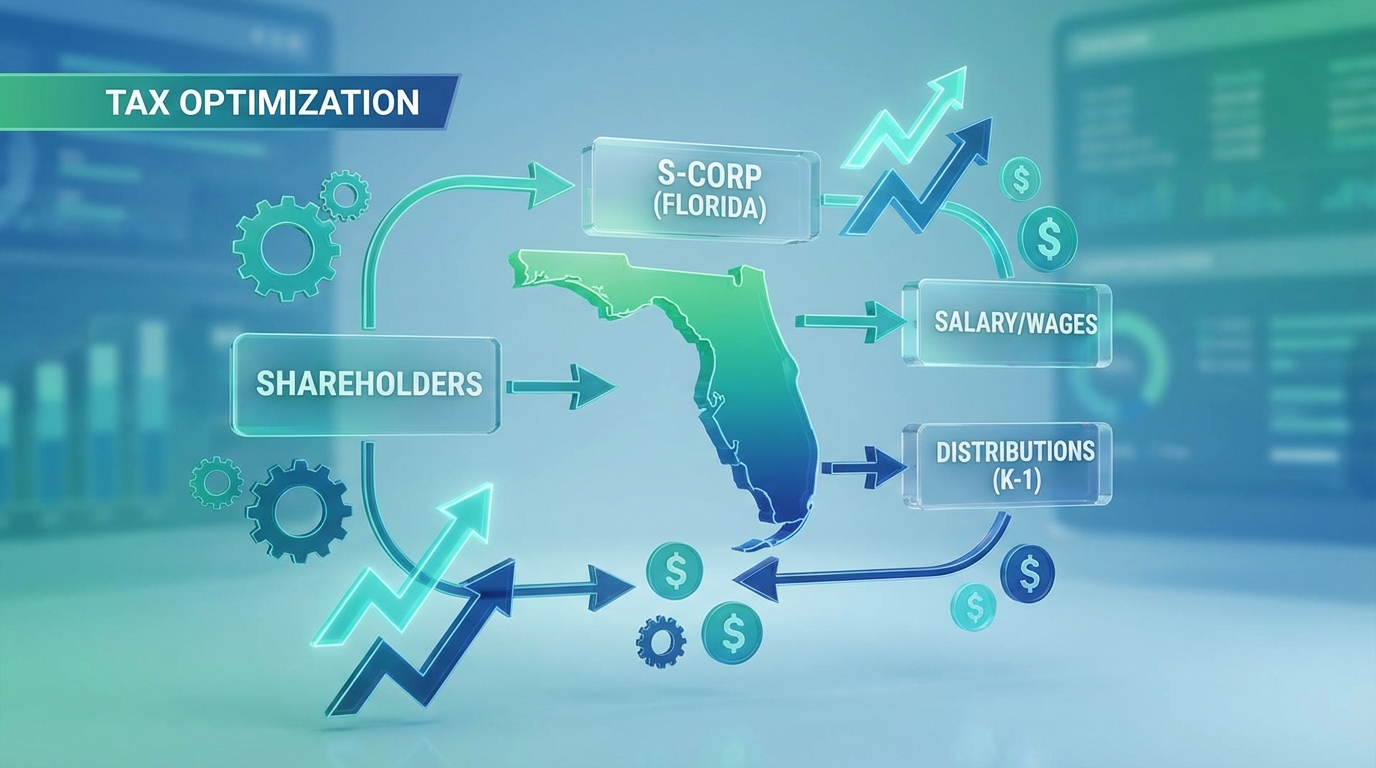
An S-Corporation (S-Corp) is not a distinct type of business entity under Florida state law. Rather, it is a federal tax classification that an eligible corporation or LLC elects by filing Form 2553 with the Internal Revenue Service (IRS). This is one of the most commonly misunderstood aspects of S-Corp status, and it directly affects how you approach your Florida annual report filing.
Here is the critical distinction every S-Corp owner must understand: At the state level, your business is registered as either a corporation (Inc., Corp.) or a limited liability company (LLC). The S-Corp election is made at the federal level with the IRS and affects how your business income is taxed. Florida does not have a separate entity type called "S-Corporation" — it simply recognizes your business as the entity type under which it was formed.
This means that for purposes of the Florida annual report, your S-Corp files as either a corporation or an LLC, depending on the underlying entity type. The S-Corp tax election does not change your state filing requirements, fees, or deadlines. Understanding this fundamental point is essential for proper compliance.
Why the Annual Report Is Essential for Your S-Corp
As an S-Corp owner in Florida, you enjoy significant tax advantages, including pass-through taxation that avoids double taxation of corporate income, and the ability to minimize self-employment taxes by paying yourself a reasonable salary and taking additional income as distributions. However, these benefits depend on your business entity remaining in good standing with the state of Florida.
The annual report is the primary mechanism for maintaining good standing. Here is why it matters for S-Corp owners specifically:
- Preserves Your Entity: If your corporation or LLC is dissolved for failure to file the annual report, your S-Corp election becomes meaningless because there is no entity to attach it to.
- Maintains Tax Benefits: A dissolved entity cannot properly file S-Corp tax returns. Dissolution can trigger complex tax consequences for all shareholders.
- Protects Liability Shield: The corporate liability protection that separates your personal assets from business liabilities depends on the entity being active and in good standing.
- Keeps Banking and Payroll Active: S-Corps typically have payroll for owner-employees. Banks and payroll providers may suspend services if your entity falls out of good standing.
- Supports IRS Compliance: The IRS may question S-Corp status if the underlying entity is not properly maintained at the state level.
Determining Your Filing Category: Corporation vs. LLC
Before filing your annual report, you need to determine the underlying entity type of your S-Corp. This determines your filing fee and which form you file:
If Your S-Corp Is a Corporation (Inc., Corp.)
- Filing Fee: $150.00
- Late Fee: $400.00
- Total if Late: $550.00
- Required Information: Officers, directors, registered agent, addresses
If Your S-Corp Is an LLC
- Filing Fee: $138.75
- Late Fee: $400.00
- Total if Late: $538.75
- Required Information: Managers/members, registered agent, addresses
If you are unsure which entity type your S-Corp is based on, you can look it up on the SunBiz website (sunbiz.org) by searching for your business name or document number. The entity listing will show whether your business is registered as a "Florida Profit Corporation" or a "Florida Limited Liability Company."
Key Deadlines for Florida S-Corp Annual Reports in 2026
The deadline is the same regardless of whether your S-Corp is structured as a corporation or LLC:
January 1, 2026: Filing Window Opens
The Florida Division of Corporations begins accepting annual report filings. We recommend filing early, especially for S-Corps where maintaining continuous good standing is critical for tax purposes.
May 1, 2026: Filing Deadline
The May 1 deadline is firm and applies universally. For S-Corp owners, this deadline carries extra weight because a lapse in entity status can have tax implications beyond just the state penalty.
After May 1: $400 Late Fee
A $400 late fee is added automatically. For a corporation-based S-Corp, the total becomes $550. For an LLC-based S-Corp, it becomes $538.75.
Third Friday of September: Administrative Dissolution/Cancellation
Failure to file by this date results in administrative dissolution (for corporations) or administrative cancellation (for LLCs). For S-Corp owners, this is especially problematic because it can trigger a termination of the S-Corp election at the federal level, requiring you to re-file Form 2553 if you reinstate the entity.
Information Required on Your S-Corp Annual Report
The information required depends on your underlying entity type:
For Corporation-Based S-Corps
- Corporate Name: Full legal name including "Inc.," "Corp.," or other corporate designator
- Document Number: Your Florida document number (typically starts with "P" for profit corporations)
- FEI/EIN: Federal Employer Identification Number
- Principal Address: Primary business address
- Mailing Address: Address for receiving mail
- Registered Agent: Name and Florida street address
- Officers and Directors: Must list at least one director and one officer (president, vice president, secretary, or treasurer). For S-Corps, all shareholders must be eligible S-Corp shareholders (U.S. citizens or residents, no more than 100 shareholders, etc.)
For LLC-Based S-Corps
- LLC Name: Full legal name including "LLC" or "L.L.C."
- Document Number: Your Florida document number (typically starts with "L" for LLCs)
- FEI/EIN: Federal Employer Identification Number
- Principal Address: Primary business address
- Mailing Address: Address for receiving mail
- Registered Agent: Name and Florida street address
- Managers/Members: At least one manager or managing member
Step-by-Step Filing Guide for S-Corp Annual Reports
Step 1: Identify Your Entity Type
Determine whether your S-Corp is structured as a corporation or LLC. Check your formation documents or look up your entity on SunBiz.
Step 2: Gather Required Information
Collect your document number, EIN, current addresses, registered agent details, and officer/director or manager/member information. For S-Corps, ensure all listed individuals meet S-Corp eligibility requirements.
Step 3: Access SunBiz
Go to sunbiz.org and navigate to the Annual Reports section. Enter your document number to access your entity's filing.
Step 4: Review and Update Information
Review all pre-populated information carefully. Update any changes in addresses, registered agent, or officer/director/manager information. Pay special attention to ensuring that the individuals listed are consistent with your S-Corp's shareholder and management structure.
Step 5: Pay and Submit
Pay the applicable filing fee ($150 for corporations, $138.75 for LLCs) and submit. Save your confirmation receipt.
Alternative: Use FloridaAnnualFiling.com
Our service handles the entire process for $99 plus the state filing fee. We verify your entity type, ensure all information is accurate, and file on your behalf. This is especially valuable for S-Corp owners who want to ensure compliance without navigating the complexity themselves. File Your Annual Report Now
Special S-Corp Considerations for the Annual Report
S-Corp Election Is Not Shown on the Annual Report
The Florida annual report does not reference your S-Corp tax election. There is no field for S-Corp status because the state does not track this — it is a federal tax matter. Your annual report will simply show your entity as a corporation or LLC.
Shareholder Eligibility and the Annual Report
While the annual report does not list shareholders directly, the officers and directors listed should be consistent with S-Corp requirements. Remember that S-Corps have strict eligibility requirements:
- Maximum 100 shareholders
- All shareholders must be U.S. citizens or resident aliens
- Shareholders must be individuals, certain trusts, or estates (not partnerships, corporations, or non-resident aliens)
- Only one class of stock is permitted
If any of these requirements are violated, the S-Corp election can be involuntarily terminated. While the annual report itself does not enforce these rules, keeping your corporate records consistent and up-to-date supports ongoing S-Corp compliance.
Impact of Dissolution on S-Corp Status
If your entity is administratively dissolved for failure to file the annual report, the consequences for your S-Corp status can be severe. The IRS may view the dissolution as a termination event, ending your S-Corp election. If you reinstate the entity, you may need to file a new Form 2553, and there may be a waiting period before a new S-election can take effect. During the gap, you could be taxed as a C-Corporation or partnership, depending on your entity type, potentially resulting in double taxation or other unfavorable tax treatment.
Reasonable Salary Requirements
S-Corp owner-employees must pay themselves a reasonable salary before taking distributions. While this is a federal tax requirement, maintaining your entity in good standing is necessary to properly run payroll. If your entity is dissolved, you cannot legally issue payroll, which can create IRS compliance problems.
Multi-State S-Corps
If your S-Corp operates in multiple states, the Florida annual report only covers your Florida entity. However, maintaining good standing in Florida is often required by other states where your S-Corp is registered as a foreign entity. A lapse in Florida could trigger compliance issues in other states as well.
Common Mistakes S-Corp Owners Make with Annual Reports
- Confusing Federal and State Requirements: The most common mistake is believing that S-Corp status changes your state filing requirements. It does not. Your annual report is based on your entity type (corporation or LLC), not your tax election.
- Missing the Deadline Due to Tax Season Distraction: S-Corp owners are often focused on federal tax deadlines (March 15 for Form 1120-S) and forget about the May 1 state filing deadline. These are separate obligations.
- Not Updating Officer Information: S-Corps with changing shareholder or officer structures must keep the annual report current. Listing former officers or directors can create confusion and legal exposure.
- Assuming the CPA or Tax Preparer Handles It: Your CPA prepares your tax returns, but the Florida annual report is a separate state filing. Unless your CPA or a service like FloridaAnnualFiling.com specifically handles this for you, it is your responsibility.
- Forgetting About the Annual Report After S-Election: Some business owners file their S-Corp election and then focus exclusively on federal tax compliance, neglecting the basic state annual report requirement that keeps their entity alive.
Why S-Corp Owners Should File Early
S-Corp owners have more at stake than other business owners when it comes to timely annual report filing. A lapse in entity status does not just result in a $400 penalty — it can jeopardize your entire tax structure. Filing early (in January or February) provides several advantages:
- Peace of Mind: Get the filing done early and focus on running your business
- Time to Correct Issues: If there are problems with your filing, you have months to resolve them
- Avoids Tax Season Overlap: January/February filing avoids the March-April rush when you are focused on tax returns
- Protects S-Corp Status: Continuous good standing protects your federal tax election
File Your Annual Report Now to protect your S-Corp status and avoid the $400 late fee.
Frequently Asked Questions About Florida S-Corp Annual Reports
Does Florida recognize S-Corp status on the annual report?
No. Florida does not have a separate entity type for S-Corporations. The S-Corp election is a federal tax classification made by filing Form 2553 with the IRS. For purposes of the Florida annual report, your business files as its underlying entity type — either a corporation or an LLC. The annual report form does not have a field for S-Corp status, and the state does not track this election.
What is the filing fee for a Florida S-Corp annual report?
The fee depends on your underlying entity type. If your S-Corp is structured as a corporation, the fee is $150.00. If structured as an LLC, the fee is $138.75. The $400 late fee applies to both if filed after May 1. Through FloridaAnnualFiling.com, our service fee is $99 plus the applicable state filing fee.
Can my S-Corp election be terminated if I do not file the annual report?
Yes, potentially. If your entity is administratively dissolved for failure to file the annual report, the IRS may view this as a termination event for your S-Corp election. You would need to reinstate your entity and potentially file a new Form 2553. During the gap, you may be subject to less favorable tax treatment. This is one of the most compelling reasons for S-Corp owners to file their annual report on time every year.
I just made my S-Corp election. Do I still need to file a Florida annual report?
Absolutely. The S-Corp election affects only your federal tax treatment. Your obligation to file the Florida annual report exists because you have a business entity (corporation or LLC) registered in Florida. The annual report is required regardless of your tax election and must be filed by May 1 each year to keep your entity in good standing.
My CPA files my S-Corp tax return. Does that cover the annual report?
No. Your CPA files your federal tax return (Form 1120-S) with the IRS. The Florida annual report is a completely separate state filing submitted to the Florida Division of Corporations through SunBiz. Unless your CPA specifically offers this service, or you use a service like FloridaAnnualFiling.com, the annual report is your responsibility to file separately.
Protect your S-Corp status and stay compliant with Florida. File Your Annual Report Now with FloridaAnnualFiling.com. For more guides, visit Read More Guides.
Related Posts

Florida Holding Company Annual Report Requirements 2026
Everything you need to know about filing annual reports for Florida holding companies in 2026. Covers entity structures, subsidiary obligations, fees, and strategies for managing compliance across multiple entities.

Florida Multi-Member LLC Annual Report: What You Need to Know
A comprehensive guide to filing Florida multi-member LLC annual reports in 2026. Learn about unique considerations for partnerships, management structures, and keeping all members informed of compliance obligations.
Florida Single-Member LLC Annual Report: Complete Guide 2026
Everything you need to know about filing a Florida single-member LLC annual report in 2026. Covers fees, deadlines, required information, and special considerations for solo LLC owners.