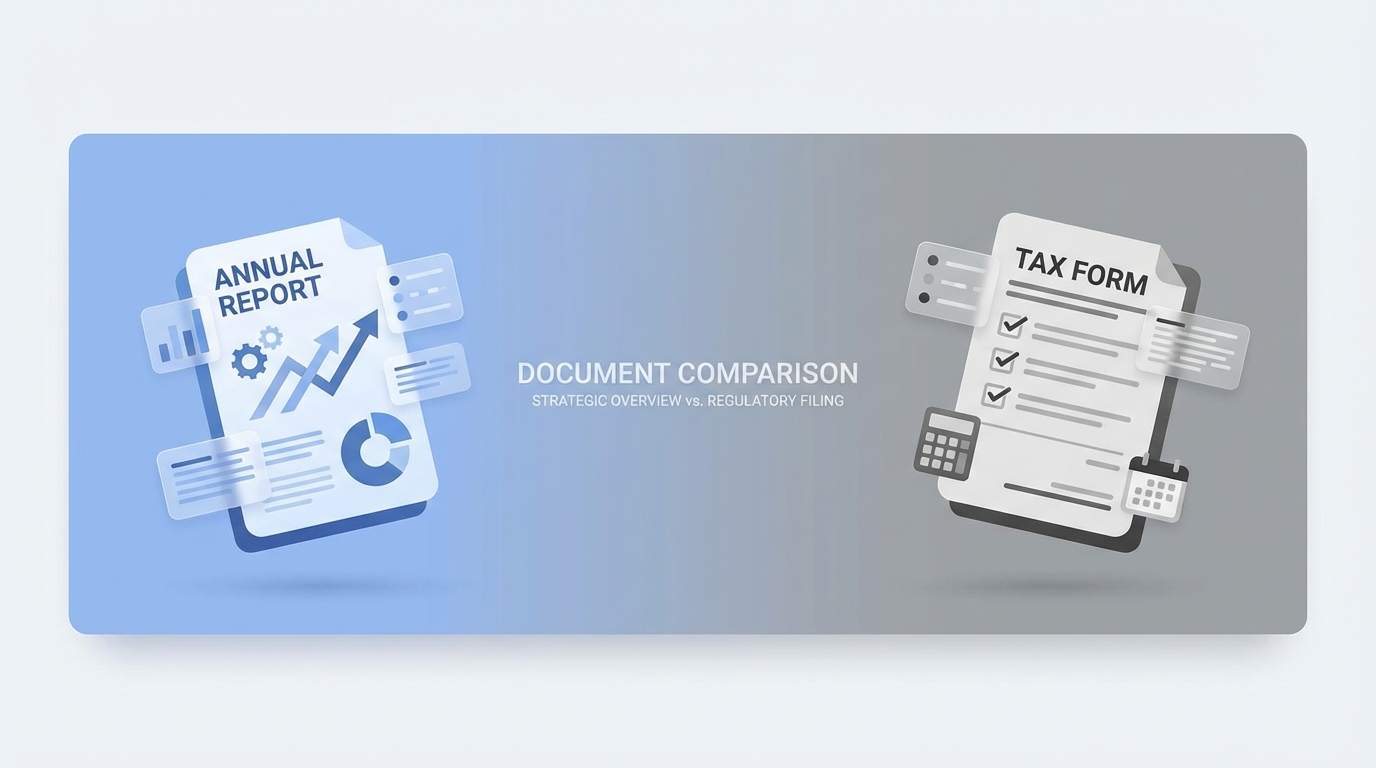
Florida Annual Report vs. Tax Return: Understanding the Key Differences in 2026
Florida Annual Report vs. Tax Return: Two Different Filings, Both Essential
One of the most common misconceptions among Florida business owners is that the annual report and the tax return are the same thing — or that filing one eliminates the need to file the other. This confusion can lead to missed deadlines, penalties, and even the dissolution of your business.
In this guide, we clearly explain the differences between the Florida annual report and tax returns, what each filing accomplishes, when each is due, and why every Florida business owner must stay on top of both. If you have ever wondered whether the Florida annual report is a tax return, this article will clear up the confusion once and for all.
What Is the Florida Annual Report?
The Florida annual report is an informational filing submitted to the Florida Division of Corporations through SunBiz.org. Its purpose is to confirm and update your business entity's records with the state. The annual report contains:
- Your business's legal name
- Principal address and mailing address
- Registered agent name and address
- Names, titles, and addresses of officers, directors, or members
- Federal Employer Identification Number (EIN)
The annual report does not contain any financial information. It does not report revenue, expenses, profits, losses, or tax obligations. It is purely an administrative filing that tells the state, "My business still exists, and here is my current contact and management information."
The annual report is required under Florida Statute 605.0212 (for LLCs) and Florida Statute 607.1622 (for corporations), and it must be filed every year between January 1 and May 1.
What Is a Tax Return?
A tax return is a financial filing submitted to a tax authority — typically the IRS (Internal Revenue Service) for federal taxes, or the Florida Department of Revenue for state taxes. Tax returns report your business's income, deductions, credits, and the amount of tax you owe (or the refund you are entitled to).
Common business tax returns include:
- IRS Form 1065 — Partnership return (for multi-member LLCs taxed as partnerships)
- IRS Form 1120 — Corporation income tax return (for C-corporations)
- IRS Form 1120-S — S-corporation income tax return
- IRS Schedule C — Profit or loss from business (for single-member LLCs and sole proprietors, filed with personal Form 1040)
- IRS Form 990 — Return for tax-exempt organizations (nonprofits)
- Florida Form F-1120 — Florida corporate income/franchise tax return
Key Differences at a Glance
Here is a side-by-side comparison of the Florida annual report and tax returns:
Purpose
- Annual Report: Updates your business entity's administrative records with the state
- Tax Return: Reports your business's financial activity and calculates tax owed
Filed With
- Annual Report: Florida Division of Corporations (via SunBiz.org)
- Tax Return: IRS (federal) and/or Florida Department of Revenue (state)
What It Contains
- Annual Report: Business name, addresses, registered agent, officer/member names — no financial data
- Tax Return: Income, expenses, deductions, credits, tax calculations — detailed financial data
When It Is Due
- Annual Report: Between January 1 and May 1 each year
- Tax Return: Varies by form — typically March 15 or April 15 for federal returns, with possible extensions
Filing Fee
- Annual Report: $138.75 (LLCs/LPs) or $150.00 (corporations) — paid to the state
- Tax Return: No filing fee, but taxes owed must be paid
Penalty for Not Filing
- Annual Report: $400 late fee after May 1; administrative dissolution after September
- Tax Return: IRS penalties and interest; potential legal action
Who Must File
- Annual Report: All entities registered with the Florida Division of Corporations
- Tax Return: All businesses with tax obligations (varies by entity type and revenue)
Florida's Tax Advantage: No State Income Tax for Individuals
One of the reasons some business owners get confused about the annual report is because Florida is one of the states with no personal state income tax. This is a significant advantage for Florida business owners, but it does not mean you have no filing obligations with the state.
Here is what Florida's no-income-tax policy means for different entity types:
LLCs and Sole Proprietorships
If your LLC is taxed as a pass-through entity (which most single-member and multi-member LLCs are), your business income passes through to your personal tax return. Since Florida has no personal income tax, you do not file a state income tax return for this income. However, you must still file your federal tax return with the IRS, and you must still file your Florida annual report with the Division of Corporations.
S-Corporations
S-corporations are also pass-through entities for tax purposes. Similar to LLCs, the income passes through to shareholders' personal returns. Florida does not tax this pass-through income at the state level. But again, federal tax returns are still required, and the annual report is still mandatory.
C-Corporations
C-corporations face a different situation. Florida imposes a corporate income tax (also called the franchise tax) on C-corporations doing business in the state. As of 2026, the Florida corporate income tax rate is 5.5% on taxable income over a certain threshold. C-corporations must file Florida Form F-1120 with the Florida Department of Revenue, in addition to their federal return (IRS Form 1120) and their Florida annual report.
Nonprofits
Tax-exempt nonprofits generally do not owe federal income tax, but they must still file IRS Form 990 (or a variant) to maintain their tax-exempt status. They must also file the Florida annual report to maintain their active status with the state. The annual report fee for nonprofits is $61.25.
Common Misconceptions
Misconception 1: "The annual report is my tax return"
The annual report has nothing to do with taxes. It is an administrative filing that updates your business records. You need to file both your annual report (with the Division of Corporations) and your tax returns (with the IRS and, if applicable, the Florida Department of Revenue).
Misconception 2: "Florida has no state taxes, so I only need to file the annual report"
While Florida has no personal income tax, C-corporations are subject to the Florida corporate income/franchise tax. Additionally, all businesses have federal tax obligations regardless of their state. The annual report and tax returns serve completely different purposes.
Misconception 3: "If my business earned no income, I don't need to file anything"
Even if your business had zero revenue, you are still required to file the annual report to maintain your entity's active status. Many businesses also need to file tax returns even when they had no income, depending on their entity type. A zero-income LLC is still required to have its annual report filed on time.
Misconception 4: "My accountant files my annual report with my taxes"
Unless your accountant specifically handles both filings, they are separate processes filed with different agencies. Your accountant files your tax returns with the IRS and/or Florida Department of Revenue, while your annual report is filed through SunBiz.org. Make sure you know who is responsible for each filing.
Misconception 5: "Filing my annual report late only affects my taxes"
Late annual report filing affects your business entity's standing with the state, not your tax situation. A $400 late fee is added after May 1, and your business can be dissolved after September. These consequences are entirely separate from any tax penalties you might face with the IRS.
Both Filings Are Critical for Your Business
While the annual report and tax returns are different filings with different agencies, both are essential for your business:
- The annual report keeps your business in good standing with the State of Florida, maintains your liability protection, and protects your right to operate under your business name
- Tax returns keep you in compliance with federal and state tax laws, avoid IRS penalties and interest, and maintain your tax-exempt status (for nonprofits)
Neglecting either filing can have serious consequences. The annual report deadline is May 1, and most federal tax return deadlines fall in March or April. Create a compliance calendar at the beginning of each year so you never miss a deadline for either filing.
A Compliance Timeline for 2026
Here is a helpful timeline for Florida business owners in 2026:
- January 1: Florida annual report filing window opens
- March 15: Federal tax return deadline for S-corporations (Form 1120-S) and partnerships (Form 1065) — extension to September 15
- April 1: Florida corporate income tax return (Form F-1120) due for calendar-year filers — may vary
- April 15: Federal individual income tax return deadline (Form 1040, including Schedule C for sole proprietors) — extension to October 15
- May 1: Florida annual report deadline — $400 late fee applies after this date
- May 15: IRS Form 990 deadline for nonprofits — extension to November 15
- Third Friday of September: Final deadline to file annual report before administrative dissolution
Frequently Asked Questions
Do I need to file both an annual report and a tax return?
In most cases, yes. The annual report is required for all entities registered with the Florida Division of Corporations, and most businesses have federal (and sometimes state) tax return obligations as well. The two filings are separate and go to different agencies.
Can I use the same information for both filings?
The annual report and tax returns require different information. The annual report requires administrative details (addresses, officers, registered agent), while tax returns require financial details (income, expenses, deductions). The only overlap is basic identifying information like your business name and EIN.
Does filing my annual report affect my taxes?
Filing your annual report does not directly affect your tax obligations. The annual report fee is not a tax — it is an administrative filing fee. However, the annual report fee may be deductible as a business expense on your tax return. Consult your accountant for details.
What if I only file my tax return and forget the annual report?
Your business will face a $400 late penalty if the annual report is not filed by May 1, and it could be administratively dissolved if not filed by the third Friday of September. Filing your tax return does not substitute for the annual report — they are completely separate requirements.
Is the annual report filing fee tax-deductible?
Generally, yes. The annual report filing fee is a legitimate business expense that can typically be deducted on your federal tax return. Check with your tax professional for guidance specific to your situation.
My accountant does my taxes — do they also file my annual report?
Not necessarily. Unless you have specifically arranged for your accountant or another professional to file your annual report, it may not be covered. Ask your accountant or use a dedicated filing service like FloridaAnnualFiling.com to ensure your annual report is filed on time.
Stay Compliant With Both Filings
Understanding the difference between your Florida annual report and your tax returns is the first step toward full compliance. Both filings protect your business in different ways, and both have deadlines that must be met.
If you want one less thing to worry about, let our team at FloridaAnnualFiling.com handle your annual report filing. We ensure your business stays in good standing with the State of Florida so you can focus on managing your finances and meeting your tax obligations. Get started with our filing service today.
Related Posts

Changing Your Business Name on a Florida Annual Report
Want to change your business name in Florida? Learn why you cannot change your entity name on the annual report, and the correct steps to file an Articles of Amendment with the Division of Corporations.

How to Update Officers and Members on Your Florida Annual Report
Need to add, remove, or change officers on your Florida annual report? This step-by-step guide covers officer update requirements for LLCs, corporations, nonprofits, and limited partnerships.
Florida Certificate of Status (Good Standing): How to Get One
A Florida Certificate of Status proves your business is in good standing with the state. Learn what it is, when you need one, how to get it, and why filing your annual report on time is essential.